

Core Focus
How Anselhill Academy converts hobbies, interests, and curiosity into structured learning outcomes.
In Part 2 and 3, we explored why understanding the child must come before teaching the subject.
But understanding alone is not enough.
The real question is:
How do we turn a child’s interests into real academic progress — without losing structure, discipline, or results?
At Anselhill Academy, interests are not used as entertainment.
They are used as pathways into learning.
Interests Are Gateways, Not Distractions

Many people believe interest-based learning means making lessons “fun” at the cost of rigour.
At Anselhill Academy, the opposite is true.
A child’s interests:
- Capture attention instantly
- Lower emotional resistance
- Create familiarity with difficult concepts
Once attention is secured, real teaching begins.
=================================================================================
Matching Interests to Academic Structure
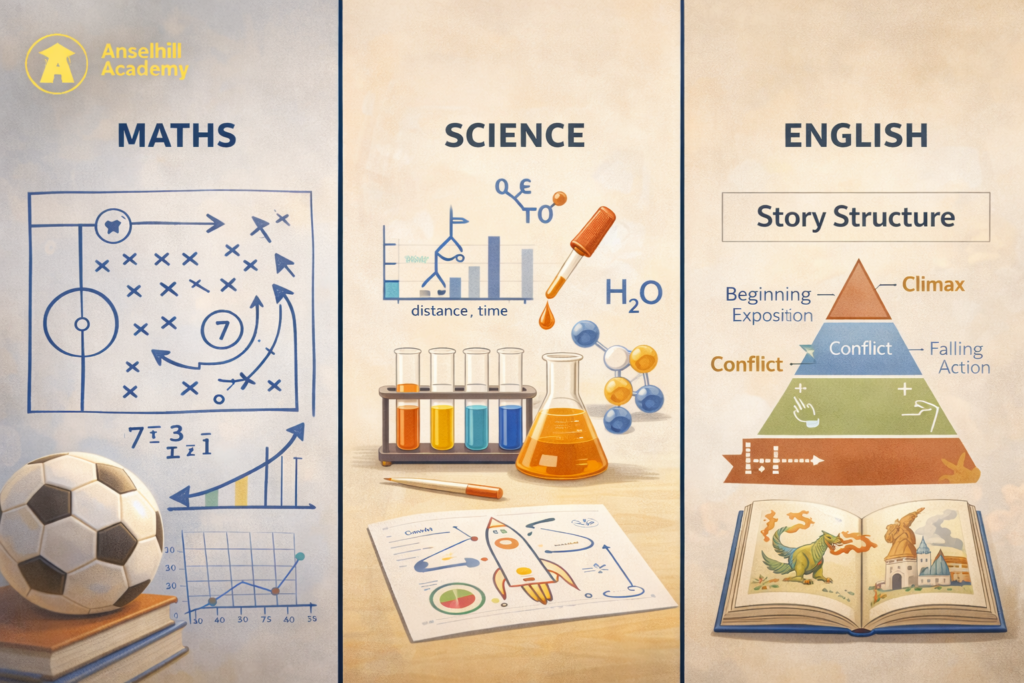
We do not change the curriculum.
We change the route into it.
For example:
- A football-loving child learns ratios, angles, and data through match statistics
- A creative child understands science through diagrams, models, and explanations
- A storytelling child masters English through narrative frameworks
The outcome remains academic.
The path becomes personal.
Structure Is What Turns Interest Into Progress
Interest alone does not create learning.
Structure does.
At Anselhill Academy, every lesson includes:
- Clear learning objectives
- Step-by-step explanations
- Guided practice
- Independent application
Interests are woven into the explanation — never replacing it.
This is how enjoyment becomes achievement.